Overview
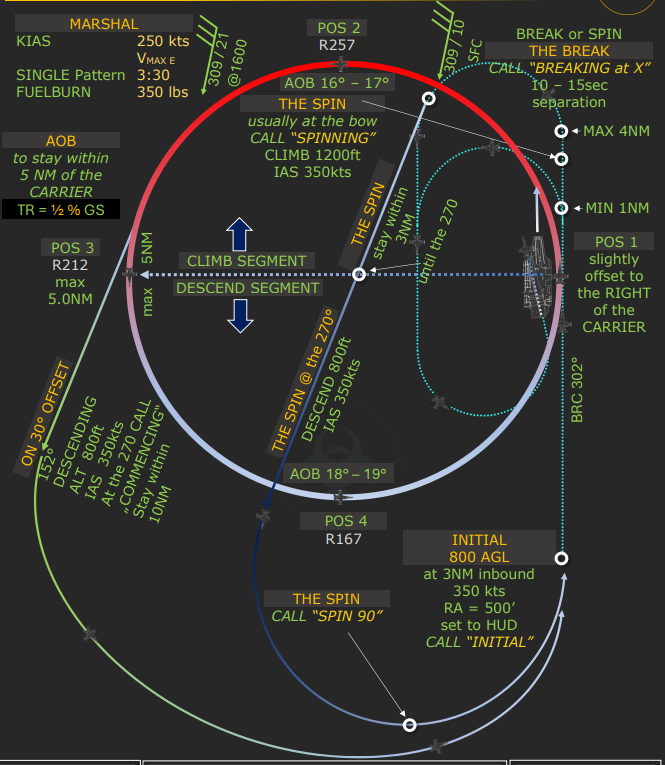
The Case 1 pattern is the most commonly used patterns for landing on an aircraft carrier.
Departure and recovery operations are classified according to meteorological conditions into Case I, Case II, or Case III.
- Case I occurs when flights are anticipated to not encounter instrument conditions (instrument meteorological conditions) during daytime departures/recoveries, and the ceiling and visibility around the carrier are no lower than 3,000 feet (910 m) and 5 nautical miles (9.3 km; 5.8 mi), respectively. Maintaining radio silence, or "zip lip", during case-I launches and recoveries is the norm, breaking radio silence only for safety-of-flight issues.
- Case II happens when flights may encounter instrument conditions during a daytime departure/recovery, and the ceiling or visibility in the carrier control zone are no lower than 1,000 feet (300 m) or 5 nautical miles (9.3 km; 5.8 mi), respectively. It is used for an overcast condition.
- Case III exists when flights are expected to encounter instrument conditions during a departure/recovery because the ceiling or visibility around the carrier is lower than 1,000 feet (300 m) and 5 nautical miles (9.3 km; 5.8 mi), respectively, or for night departures/recoveries.
This picture shows how a complete case 1 approach should look like, and how a spin pattern is usually flown: