
Overview
The Case 1 pattern is the most commonly used patterns for landing on an aircraft carrier.
Departure and recovery operations are classified according to meteorological conditions into Case I, Case II, or Case III.
- Case I occurs when flights are anticipated to not encounter instrument conditions (instrument meteorological conditions) during daytime departures/recoveries, and the ceiling and visibility around the carrier are no lower than 3,000 feet (910 m) and 5 nautical miles (9.3 km; 5.8 mi), respectively. Maintaining radio silence, or "zip lip", during case-I launches and recoveries is the norm, breaking radio silence only for safety-of-flight issues.
- Case II happens when flights may encounter instrument conditions during a daytime departure/recovery, and the ceiling or visibility in the carrier control zone are no lower than 1,000 feet (300 m) or 5 nautical miles (9.3 km; 5.8 mi), respectively. It is used for an overcast condition.
- Case III exists when flights are expected to encounter instrument conditions during a departure/recovery because the ceiling or visibility around the carrier is lower than 1,000 feet (300 m) and 5 nautical miles (9.3 km; 5.8 mi), respectively, or for night departures/recoveries.
This picture shows how a complete case 1 approach should look like, and how a spin pattern is usually flown:
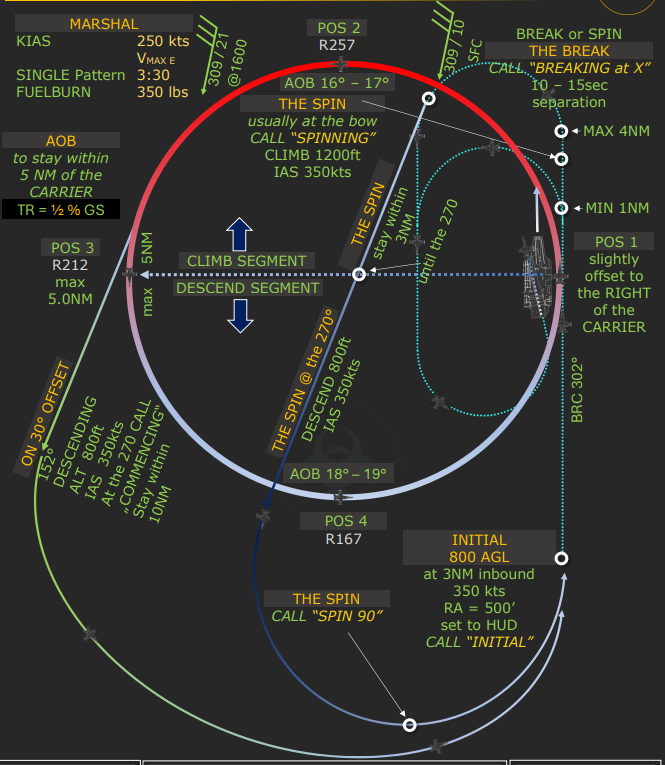
- Flight lead announces intention to land 50 nm away from the carrier.
- Flight lead calls "see you at xx" (usually 10 nm away) and descends to given altitude.
- Enter the marshall stack at points 3 or 4.
- Leave the stack and commence after you got a signal is charlie (commence heading: BRC +/- 180 degrees + 30 degrees).
- Descend to 800ft and speed up to 350kts.
- Overfly Pos 1.
- Break 14s after the flight member in front of you.
- Fly the case 1 pattern in a predictable way with the correct speeds and distances to reference points.
- Land on the deck ("foul deck"), then clear the way asap for the next fighter to land ("green deck").
- If theres something that prevents you to land, perform a waveoff and call that to all other flights in the pattern.
- If you are in a flight behind another flight that is currently landing and your separation is too small, perform a spin ("spinning"). Every other flight behind that already commenced now also has to fly a spin pattern.