
Landing Signal Officer (LSO) State Feedback Guide
During carrier landings, the Landing Signal Officer (LSO) provides critical feedback to help pilots maintain a safe and accurate approach. The chart above represents a standardized matrix used by LSOs to assess aircraft state in terms of altitude, angle of attack (AOA), speed, and alignment with the landing area.
Matrix: Altitude vs AOA
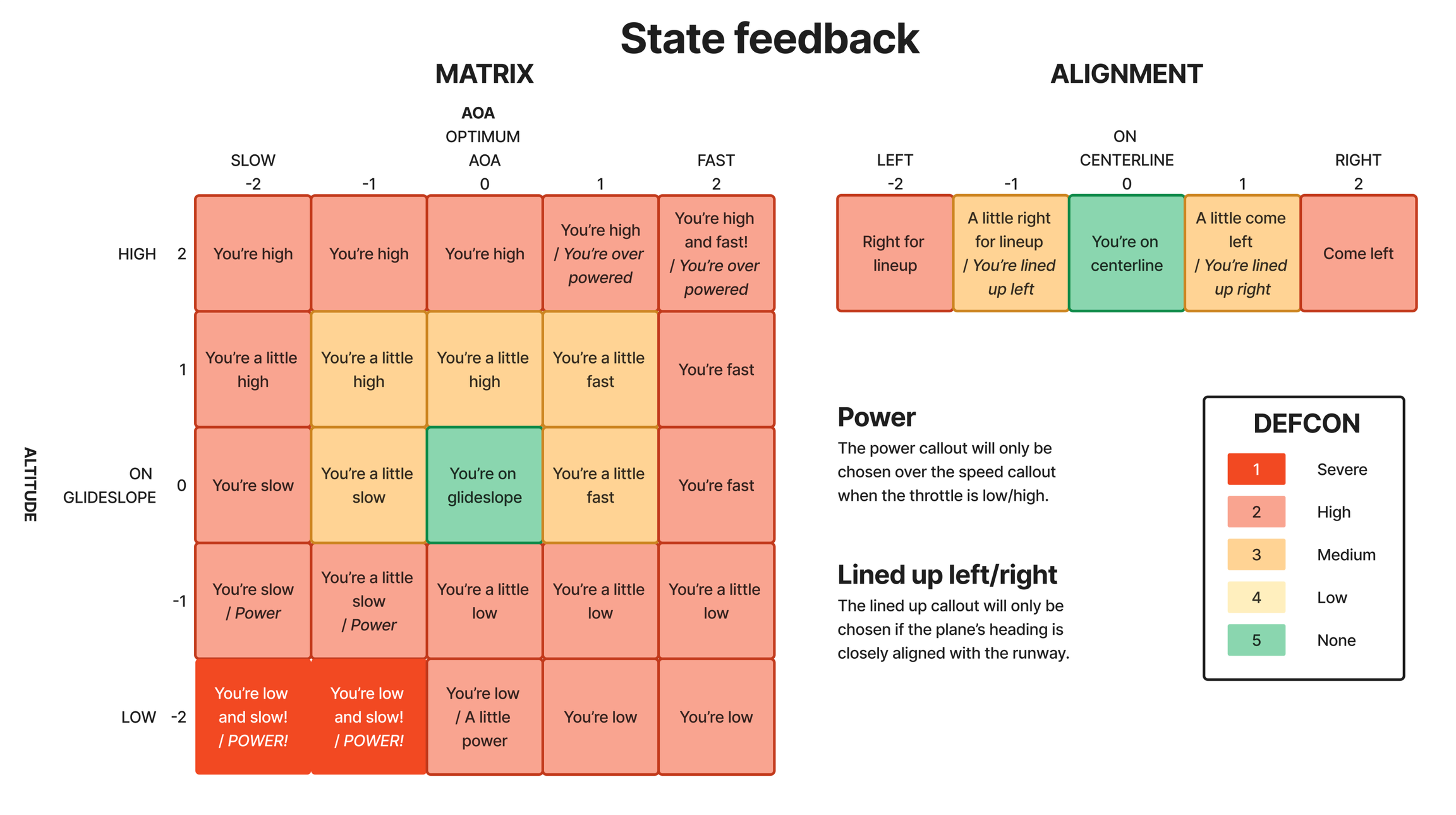
The Matrix section of the chart gives feedback based on a combination of the aircraft’s altitude (vertical position relative to the ideal glideslope) and AOA (which reflects energy state—too fast or too slow).
-
The center of the matrix (0,0) is the ideal zone: "You're on glideslope" at optimum AOA.
-
Movement away from the center reflects increasing deviation:
-
High and fast = "You're high and fast! / You're overpowered"
-
Low and slow = "You're low and slow! / POWER!"
-
-
Color coding indicates severity, from green (ideal) to red (severe deviation), aligning with a DEFCON-style system:
-
DEFCON 5 (Green): Perfect
-
DEFCON 4 (Light Green): Slight deviation
-
DEFCON 3 (Yellow): Moderate deviation
-
DEFCON 2 (Orange): High risk
-
DEFCON 1 (Red): Critical state, immediate correction needed
-
Alignment Feedback
The Alignment section indicates the aircraft's lateral position relative to the centerline of the runway:
-
0: "You're on centerline" – perfectly aligned.
-
±1: Slight deviations — "A little right for lineup / You’re lined up left"
-
±2: Major deviations — "Right for lineup" or "Come left"
An important note: Lined up left/right callouts are only made if the aircraft’s heading is closely aligned with the runway but offset laterally. This prevents confusing heading misalignments with position deviations.
Power Callouts
When determining whether to call out speed or power, power takes priority if the aircraft’s throttle setting is dangerously high or low. This ensures throttle corrections are addressed before secondary speed concerns.