
Landing Pattern
This guide provides a concise, authoritative reference for DCS F/A-18C pilots flying U.S. Navy Case I overhead patterns. All procedures reflect U.S. Navy CV NATOPS, LSO NATOPS, F/A-18C NATOPS, and CNATRA guidance.
Initial
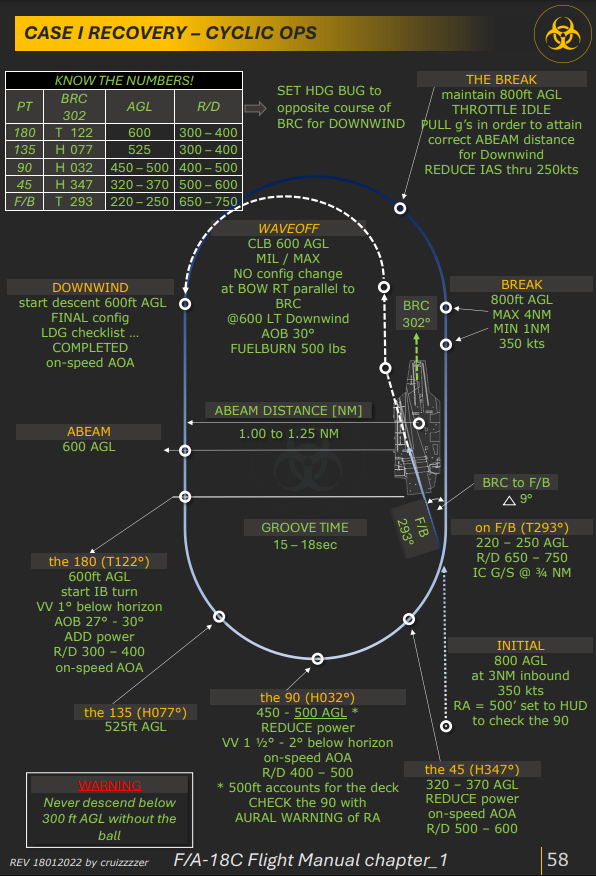
The Case I carrier landing pattern is a left-hand overhead visual pattern flown in VMC. The pattern begins at the Initial, located 3 NM astern of the carrier at 800 feet and approximately 350 knots, slightly offset to the starboard side. Aircraft enter configured for landing, hook down and lights on. Upon arrival at the Initial, aircraft continue flying BRC until entering the break turn.
Break Turn
The break is a 180-degree left turn flown level at 800 feet. The break is initiated any time after passing the ship, but no later then 4nm ahead of the ship. Pilots reduce power, extend speed brakes, flaps, and landing gear once below 250 knots. Aim to roll out into the downwind at 600ft and 1.1 to 1.3 NM parallel to BRC.
Downwind
Downwind is flown parallel to the ship’s course (reciprocal of BRC), with the aircraft at 600 feet positioned 1.1 to 1.3 NM abeam the BRC. The descent from 800 to 600 feet should occur prior to the 180 position. The aircraft should be fully configured, checklist complete, and trimmed on-speed before reaching the abeam position.
Abeam and Approach Turn
The abeam (180) is directly opposite the intended landing spot, usually the LSO platform. The approach turn should be initiated shortly after this position, when the round down of the deck is first viable, in order to get the correct groove time. This left turn should be performed at 600 feet and on-speed, descending using 25 to 30 degrees of AOB depending on weight.
90-Degree Position and wake
As the aircraft reaches the 90-degree position, roughly halfway through the turn, it should be at approximately 450 to 500 feet, 1.2 NM from the carrier, and continuing a controlled descent. At the wake, the aircraft should be approximately 380ft and 45 degrees offset from the BRC.
Groove Entry
The turn should place the aircraft wings-level and aligned with the carrier’s angled deck centerline at the groove entry, roughly 0.75 NM astern of the ship at 340 to 360 feet. This point, known as the Start, begins the final approach segment known as the Groove, which lasts approximately 15 to 18 seconds.
Ball Call and Final Approach
At the Start, the pilot should make the Ball call (e.g., "Hornet 205, Ball, (fuel state) 3.2") if not under zip lip. The aircraft must be on-speed, ball centered, and lined up with the landing area. Glideslope is maintained with power, lineup with small roll corrections, and AoA with pitch trimming. After passing the carrier's bow, the aircraft should maintain its trajectory, without further corrections. The target is to get arresting wire #3. Upon touchdown, the pilot adds MIL or afterburner power in case of a bolter and only reduces throttle once a successful arrestment is confirmed.
Wave-Off and Bolter
If a wave-off or bolter occurs, the pilot immediately applies full power, maintains on-speed AoA, and climbs along the angled deck heading until past the bow. A clearing turn to the right is then executed to the BRC. The aircraft climbs back to 600 feet, remains in landing configuration, and breaks no earlier then 1nm from the ship.
Best Practices
Maintaining discipline in pattern geometry, timing, and configuration is critical for safe and consistent Case I landings. Trim early, manage interval, and fly a smooth, predictable approach. Use the IFLOLS for glideslope, maintain lineup throughout the groove, and always be ready to wave off or bolter if the approach becomes unstable.
EeferenceReference Image
Sources: CV NATOPS, LSO NATOPS, F/A-18C NATOPS, CNATRA FCLP and Carrier Qualification Guides.